
Beyond the Conference Hall: Memories and Lessons from ICOSS
I was once just a child who dreamed of one day representing my heritage on a great avenue. There were opportunities I failed to reach, both nationally and internationally. And for a long time, those missed chances stayed with me. That is why, when I look back on my ICOSS 2025 journey, I cannot help but feel the weight and meaning of the experience. For the first time, I left my home country not merely to travel, but to take part in work that carried
meaning.
As our plane departed the Philippines, the first sight of Thailand that greeted me was the expansive aerial view of rice fields stretched neatly across the landscape like a canvas. There it hit me, feeling a sense of fear in arriving somewhere unfamiliar, without guidance, but it was outweighed by a deeper hunger for growth and the pursuit of knowledge. I did not attend ICOSS simply to fulfill a personal aspiration. I carried with me the stories and lived realities of Filipina women who entrusted us with deeply personal parts of their lives, opening sacred spaces that is only reserved for a select few, all because of our research on intercultural marriage. The conference became a space where narratives often overlooked and rarely heard, yet often scrutinized were finally given attention and dignity.
That, to me, is the strength of the social sciences: the ability to bring depth and humanity into issues too often reduced to statistics, formulas, test subjects, or surfacelevel narratives. Prof. Gupta’s keynote resonated with me deeply, particularly her point that climate issues are not merely natural crises, but systemic ones. The social sciences allow us to ask more difficult questions, uncover hidden structures, and imagine solutions beyond the obvious. Many dismiss the field as a “soft science,” yet I have come to see that softness as one of its greatest strengths. Its fluidity allows it to adapt, to listen, and to examine the spaces that rigid frameworks often fail to reach. What may seem purely theoretical can still create tangible and lasting impact in people’s lives.
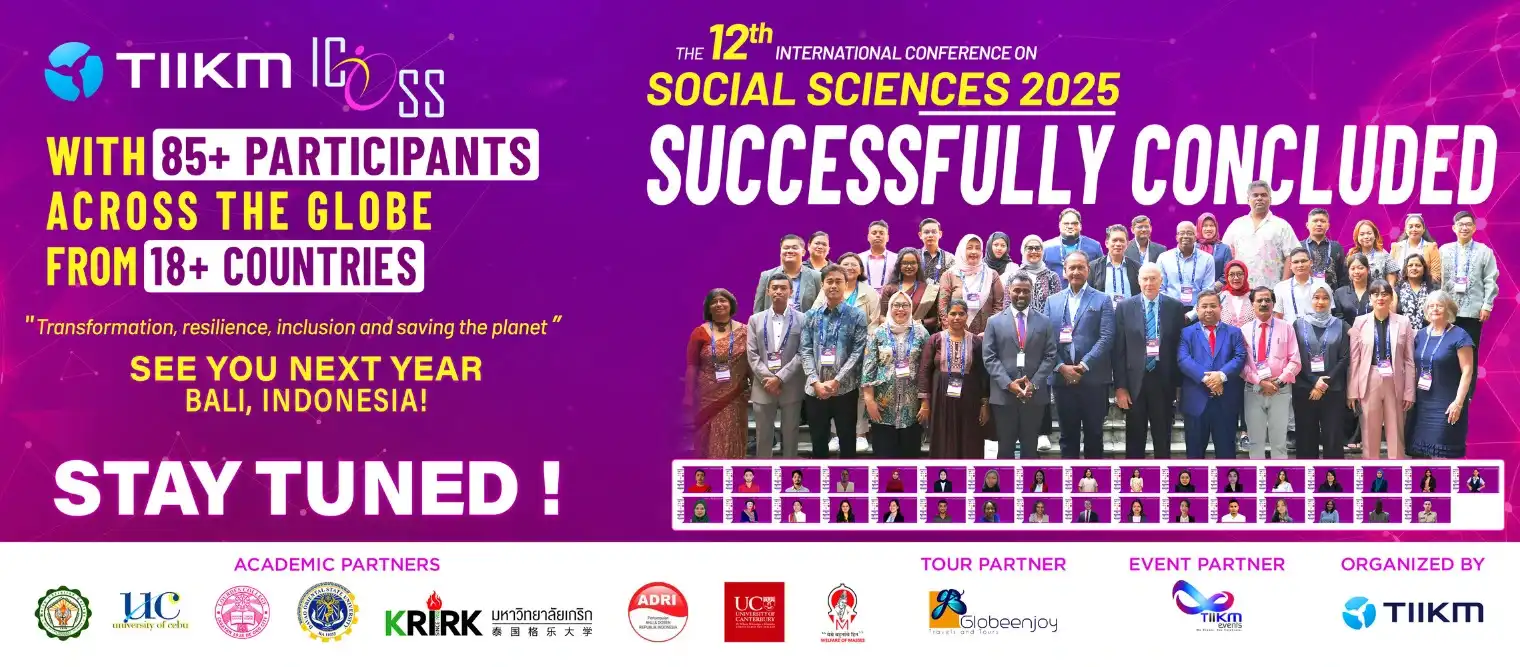
ICOSS also reminded me that knowledge is never meant to exist in isolation. The conference showed the importance of interdependence, of working across disciplines, cultures, and perspectives toward a common good. What continues to stay with me is the humility of the people I met there. Despite their accomplishments and stature in academia, they never looked down on someone like me, an undergraduate still learning and finding his place. They did not treat my limited knowledge and experience as weakness to exploit, but as something worth nurturing and engaging with. Their openness reminded me that knowledge should never be gatekept; it should be expanded and made accessible. The friendships formed along the way only made the experience more meaningful.
Of course, no conference abroad would be complete without its small side quests. Between presentations and discussions were moments spent eating pad thai and mango sticky rice, exploring unfamiliar streets, and immersing myself in Thai culture. It was exhausting trying to fit so much into such a short time, but every moment felt worthwhile. Oddly enough, the flight home felt more empowering than emotional. Participating in ICOSS 2025 was a privilege that many are never given the opportunity to experience. Because of that, I feel a responsibility not only to carry what I learned, but to put it into practice back home. The conference reminded me that meaningful change begins with listening, truly listening, to people whose voices are often unheard. If the social sciences have taught me anything, it is that understanding people deeply is itself a form of service. And perhaps that is where transformation begins: in making our communities, and ultimately the world, a little more humane, having a heart that is willing to understand.